
Montreal gained a new gateway this morning as MET, the city's second commercial airport, welcomed its first passengers through the YHU Terminal. Porter Airlines launched service to Vancouver, the first of 11 new routes linking Quebec's South Shore to cities across Canada. For travellers planning trips around World Cup season, the launch adds a timely new option beyond Trudeau.
Montreal woke up to a new travel option this morning. The MET, Montreal Metropolitan Airport, officially opened its YHU Terminal and welcomed its very first passengers, marking the start of commercial operations at a facility that has been more than three years in the making. Located about 15 kilometres from downtown Montreal in Longueuil's Saint-Hubert borough, the airport was long known as Saint-Hubert Airport and has spent most of its nearly century-long history handling general aviation, flight training and cargo traffic rather than scheduled passenger service.
That changes now, and for travellers weighing their options this summer, particularly with FIFA World Cup 2026 matches drawing crowds to Toronto and Vancouver, a second Montreal airport is worth considering.
A milestone morning on the South Shore
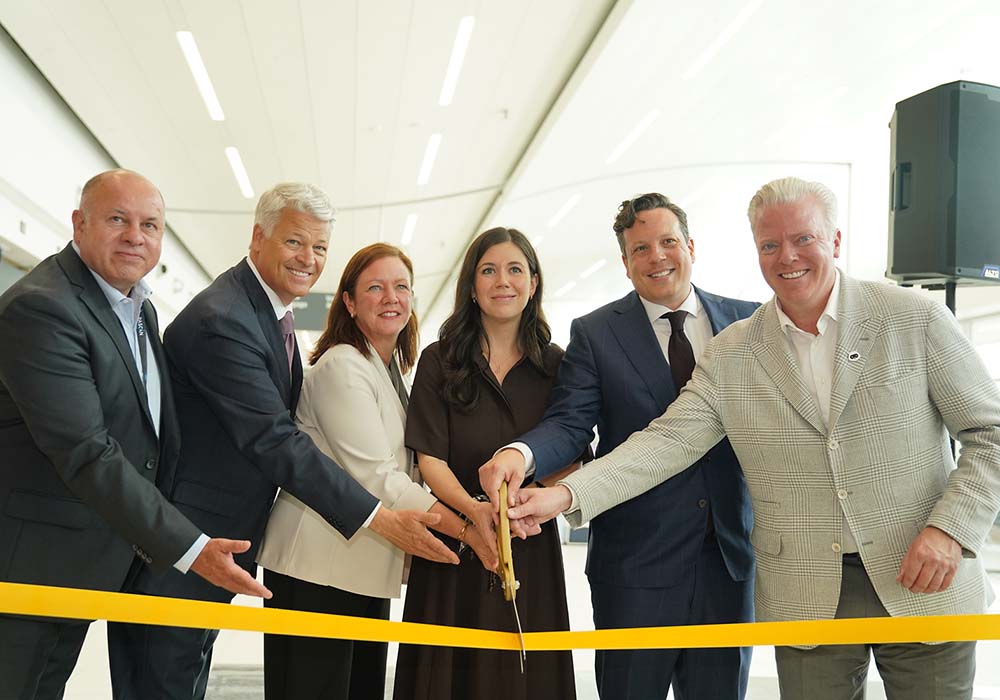
Porter Airlines' inaugural flight from MET to Vancouver departed this morning and was greeted with a water salute from the airport fire service, a long-standing aviation tradition reserved for milestone moments. The send-off was accompanied by a formal ribbon-cutting ceremony attended by Longueuil Mayor Catherine Fournier, Quebec Minister of Tourism Amélie Dionne, YHU Terminal President and CEO Charles Roberge, MET Interim President Simon-Pierre Diamond, Porter Airlines CEO Michael Deluce, and Pascan Aviation Co-owner and Vice-President Yani Gagnon. Diamond noted that the project reflects years of collaboration between citizens and elected officials, adding that roughly 80 percent of the South Shore population supports the airport.
The terminal itself, developed and operated by YHU Infrastructure Partners under a long-term lease with the MET airport authority, represents a joint venture between Porter Aviation Holdings and Macquarie Asset Management. The facility covers about 21,000 square metres and includes nine boarding bridges and 28 check-in counters, with a capacity of up to 4 million passengers annually.
Local officials also pointed to community benefits built into the project, including a ban on overnight flights, regulated operating hours, air quality monitoring and more than eight million dollars in developer-funded road improvements for the surrounding area.
Where you can fly from MET
Porter Airlines is the launch carrier at MET, and the airline is not easing in slowly. Four routes began operating today, connecting Montreal's new airport to Vancouver, Toronto Pearson, Billy Bishop Toronto City Airport and St. John's. Seven additional destinations will be added over the following week, bringing the total network to 11 domestic routes. A separate count from Porter puts the eventual total at twelve routes once seasonal service to smaller markets ramps up, including Quebec City, Toronto City, Toronto Pearson, Vancouver, Edmonton, Calgary, Halifax, Charlottetown, Winnipeg, Moncton and Hamilton, with four of those routes running seasonally.
| Destination | Airport code | Notes |
|---|---|---|
| Vancouver | YVR | Launch day route, June 15 |
| Toronto Pearson | YYZ | Launch day route, June 15 |
| Toronto City (Billy Bishop) | YTZ | Launch day route, June 15 |
| St. John's | YYT | Launch day route, June 15; seasonal |
| Calgary | YYC | Added within first week |
| Edmonton | YEG | Added within first week |
| Halifax | YHZ | Added within first week |
| Quebec City | YQB | Added within first week |
| Charlottetown | YYG | Added within first week; seasonal |
| Winnipeg | YWG | Added within first week; seasonal |
| Moncton | YQM | Added within first week; seasonal |
| Hamilton | YHM | Added within first week |
For now, MET is domestic only. Regulatory requirements for customs and border infrastructure mean the airport cannot yet handle transborder or international flights, so anyone connecting through the United States or overseas will still want to use Montreal-Trudeau. Porter says it plans to keep operating its existing schedule at Trudeau alongside the new MET routes, giving Montreal travellers a genuine choice of airport rather than a replacement for one.
What flying from MET actually feels like
Porter has built its brand around making economy travel feel less like a compromise, and that positioning carries over to the new terminal. Flights are operated using a mix of Embraer E195-E2 jets and De Havilland Dash 8-400 turboprops, both configured with two-by-two seating and no middle seat. Passengers connecting onward through Pascan Aviation, which has served Quebec's regions from Saint-Hubert for more than two decades, can book a single ticket that automatically transfers baggage between the two carriers, simplifying trips to smaller communities across the province and the Maritimes.
A few practical details are worth knowing before booking:
- The terminal sits about 15 to 20 kilometres from downtown Montreal, closer for many South Shore residents than Trudeau
- A shuttle service called METbus, run in partnership with the Réseau de transport de Longueuil, connects the terminal to the Longueuil–Université-de-Sherbrooke metro station roughly every 35 minutes
- Porter's cabin service includes complimentary snacks and drinks served in real glassware on select routes, along with free WiFi on the E195-E2 fleet
- Tickets are already on sale through flyporter.com and standard travel agency channels
Why this matters for Toronto and Vancouver travellers
The timing is notable. With FIFA World Cup 2026 matches underway in host cities including Toronto and Vancouver, a new direct link between Montreal and both of those markets gives sports fans and casual travellers alike another way to move between host cities without funnelling through a single congested hub. Toronto Pearson gets the highest flight frequency of any MET route, while Vancouver ties Halifax as one of the network's larger destinations by weekly departures. For anyone building a multi-city Canadian itinerary around this summer's tournament, that added capacity is a genuine practical benefit rather than just a nice-to-have.
Beyond the World Cup window, the broader case for MET is about choice and convenience. Porter and airport officials expect the facility to handle around 1 million passengers in its first year, rising to 4 million annually as the route network matures. Whether that translates into consistently lower fares remains to be seen, but a second commercial airport typically brings at least some competitive pressure on pricing, along with shorter lines and faster processing that come with a smaller, newer facility.
A gateway built for what comes next
The opening of MET marks a genuine shift in how Greater Montreal connects to the rest of the country, and its early momentum, with eleven routes launched within a single week, suggests the airport intends to establish itself quickly rather than grow cautiously. For travellers on the South Shore or anyone tired of the congestion at Trudeau, the new terminal offers a faster, more compact alternative, built from the outset with a clear focus on comfort and community input.
It is still early days, and international service remains off the table until the regulatory picture changes, so Trudeau will keep its role as Montreal's main gateway for the foreseeable future. But for domestic travel, especially to destinations like Vancouver and Toronto during a summer already packed with reasons to move around the country, MET gives Canadian travellers one more well-placed option worth checking before booking.