
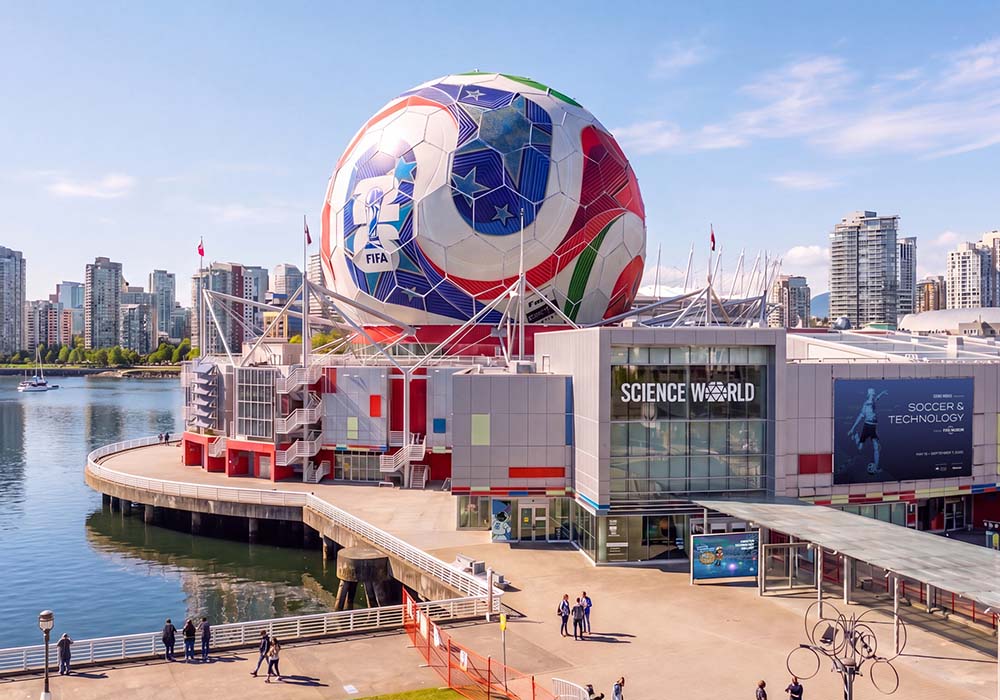
Vancouver's Science World is pulling off one of the boldest visual stunts of the FIFA World Cup 2026: transforming its beloved geodesic dome into a full-scale, 360-degree replica of the adidas Trionda, the tournament's official match ball. Dubbed "The Beautiful Dome," the installation covers the iconic 40-metre sphere with 131 custom panels. Inside, a landmark FIFA Museum exhibition opens on May 15. Here's everything travellers need to know.
Vancouver has always had a flair for the dramatic. The city that stunned the world at Expo 86, and again at the 2010 Winter Olympics, is doing it once more with one of the most creative landmark activations the FIFA World Cup 2026 has seen so far. Starting 6 May 2026, Science World's famous geodesic dome, perched beside False Creek in the heart of the city, is being wrapped in 131 custom-shaped panels to recreate the adidas Trionda: The official match ball of the 2026 tournament.
The result is "The Beautiful Dome," a 40-metre-diameter, 360-degree spectacle designed to become one of the defining visual images of this once-in-a-generation sporting event. It's a bold, ambitious engineering feat, and for any traveller heading to Vancouver this summer, it's an unmissable sight.
Installation began on May 6 and is expected to take roughly four weeks to complete, weather permitting, with the full reveal anticipated in early June. The timing is deliberate: Vancouver Stadium (officially BC Place) hosts its first World Cup match on 13 June, and the venue will host seven matches during the tournament, including Canada's national team games during the group stage. The dome will be in full glory well before the opening whistle.
What is the adidas Trionda?
The name Trionda comes from the Spanish for "three waves," a nod to the three nations hosting the FIFA World Cup 2026 for the first time in tournament history: Canada, Mexico and the United States. The ball's design reflects this historic collaboration through unique, innovative features that symbolize connection across borders. It's a fittingly symbolic choice for the centrepiece of Vancouver's FIFA transformation, a city that itself stands at the crossroads of Pacific and North American cultures.
The Trionda isn't purely decorative, either. The official match ball for the FIFA World Cup 2026 features a new layer that holds a motion sensor designed to link the ball to the broader technological ecosystem of the game. More on that below.
Why Science World?
Forty years after it first welcomed the world at Expo 86, the dome that now houses Science World is proud to be part of another extraordinary moment in Vancouver's history, said Tracy Redies, President and CEO of Science World. The building has an almost mythic status in the city, visible from the water, the bridge and the seawall and recognizable to anyone who has ever spent time in Vancouver. Wrapping it in the imagery of the world's largest single-sport event is a statement that lands.
Located in False Creek, a stone's throw from BC Place, where seven matches will be held during this year's tournament, the science museum is also hosting an exhibition to coincide with the football festivities. The geography alone makes the area one of the most concentrated World Cup experiences in the city.
The project is the result of broad collaboration. Partners behind the installation include Destination Vancouver, the Province of B.C., the FIFA World Cup 2026 Vancouver Host Committee and the Vancouver Hotel Destination Association. Installation is being overseen by The Look Company, a Canadian firm founded in 1998 with deep expertise in transforming retail and sporting environments at scale.
Soccer and Technology from the FIFA Museum
The dome transformation is the visual centrepiece, but the experience inside Science World is equally compelling. Soccer and Technology from the FIFA Museum makes its North American debut at Science World on 15 May 2026, as Vancouver prepares to welcome the world to the FIFA World Cup 2026. From the pitch to the broadcast studio, the exhibition takes visitors on a journey through the technologies that influence how football is played, analyzed and experienced today.
It highlights how innovation supports key moments in the game, from refereeing decisions and performance analysis to the way matches are delivered to fans around the world. At the same time, the exhibition shows how technology has developed alongside football, demonstrating how the game continues to evolve while keeping its human essence at its centre.
The exhibition is organized into five distinct zones and features some genuinely remarkable objects. Highlights include:
- The adidas Trionda's connected match ball technology, revealing how the embedded motion sensor feeds real-time data into the officiating and broadcast systems used at the highest level of the game
- Christine Sinclair's jersey from Canada's historic gold-medal-winning match against Sweden at the Tokyo 2020 Olympics
- The match ball from Canada vs. Croatia at FIFA World Cup 2022, the game in which Alphonso Davies scored Canada's first-ever men's World Cup goal
- Atiba Hutchinson's captain's jersey from Canada's opening match at Qatar 2022 against Belgium
- Refereeing tools and officiating systems, including the technologies behind VAR and semi-automated offside detection
Designed as an immersive experience, the exhibition invites visitors to look beyond the surface of the game and understand the role of data, innovation and technology in shaping football today and in the future.
The exhibition runs from 15 May to 7 September 2026, overlapping with all seven of Vancouver's World Cup matches at BC Place.
Vancouver's World Cup match schedule at BC Place
For travellers planning their trip around the football itself, here's the full schedule of matches at Vancouver Stadium (BC Place):
| Date | Match | Kick-off (PT) |
|---|---|---|
| Saturday, 13 June | Australia vs. Türkiye | 9:00 PM |
| Wednesday, 18 June | Canada vs. Qatar | 3:00 PM |
| Saturday, 21 June | New Zealand vs. Egypt | 6:00 PM |
| Tuesday, 24 June | Switzerland vs. Canada | 12:00 PM |
| Thursday, 26 June | New Zealand vs. Belgium | 8:00 PM |
| Thursday, 2 July | Round of 32 | 8:00 PM |
| Tuesday, 7 July | Round of 16 | 1:00 PM |
Canada plays twice at home, making Vancouver the emotional epicentre of Canada's World Cup campaign. Both decisive group-stage games are here, the matches that will determine whether Canada advances from Group B at their first World Cup since 1986.
A quick transit note for match-goers: on match days, access from Stadium-Chinatown SkyTrain station to BC Place is not permitted. The correct station is Main Street–Science World (Expo Line), with a designated pedestrian route to the stadium entrance of approximately 10-15 minutes on foot.
The bigger picture for British Columbia
This installation is about more than a great photo opportunity, significant as that is. With reports that some US cities, adjusting to lower-than-anticipated visitor bookings, are scaling back their World Cup spending, Vancouver is going the other way, embracing the opportunity to showcase itself on the global sporting stage.
Royce Chwin, President and CEO of Destination Vancouver, described the project as an investment in telling British Columbia's global story: a commitment to delivering an unforgettable visitor experience while building lasting economic and community benefits for the province. B.C. Minister of Tourism, Arts, Culture and Sport Anne Kang echoed that ambition, noting that the FIFA World Cup 2026 is capturing global attention and that the dome transformation is a vehicle for turning that spotlight into durable benefits for people across the province.
Planning your visit to Science World
Science World is located at 1455 Quebec Street in Vancouver, directly on the False Creek waterfront and within easy walking distance of the Main Street–Science World SkyTrain station. General admission tickets are available at scienceworld.ca, and the Soccer and Technology exhibition is included with entry. Visitors are strongly encouraged to book in advance, particularly around match days, when the surrounding area will be significantly busier than usual.
The FIFA Fan Festival is slated for the PNE at Hastings Park, with free entry and live match screenings across the tournament. Combined with the dome installation and the FIFA Museum exhibition, this puts Vancouver in a strong position as one of the most immersive World Cup cities on the continent.
Worth the trip, with or without a ticket
For anyone already planning a summer visit to Vancouver, the timing could hardly be better. The city is at its best in June and July. It's warm, dry, and buzzing with energy even in a normal year. In 2026, that energy is going to be extraordinary.
The Beautiful Dome will be visible from the waterfront, from the Cambie Bridge and from across False Creek for the entire summer. It will feature prominently in broadcast coverage beamed to a global audience. And inside Science World, the FIFA Museum exhibition offers a genuinely substantive look at the technology behind the modern game, anchored in Canadian football history, which gives the whole experience a local dimension worth savouring.
Whether you're in Vancouver for the matches, the museums or simply the summer, Science World's transformation into a giant football is the kind of thing you'll remember for a long time. Forty years on from Expo 86, Vancouver is doing what it does well: welcoming the world with creativity, ambition and a skyline that speaks for itself.
Visit scienceworld.ca for tickets and exhibition details. For match schedules and FIFA Fan Festival information, visit vancouverfwc26.ca.